- 23 Jan 2027 to 11 Apr 2027
- 12 Weeks | 40 Hours
- Blended (Online + On-campus)
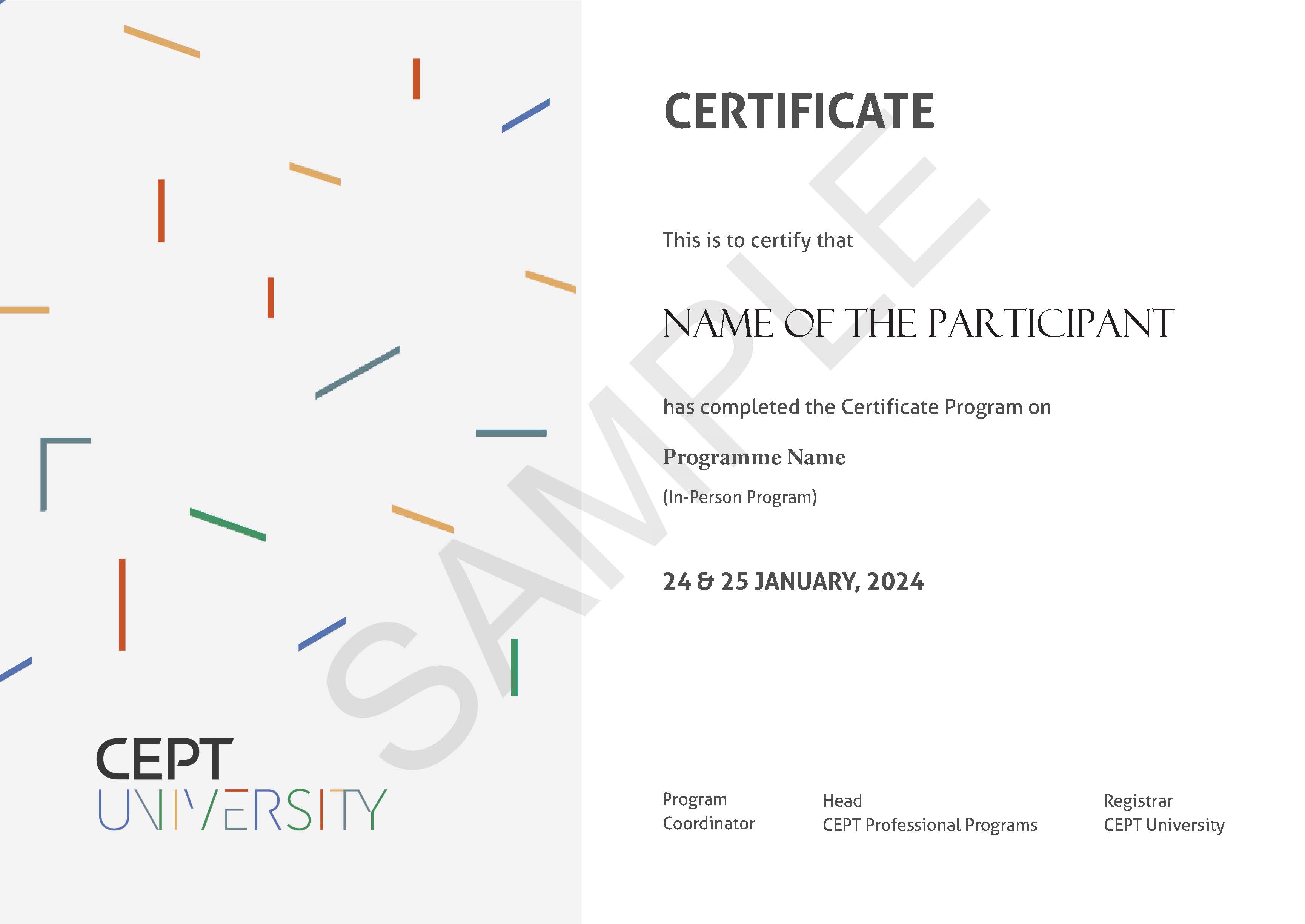
- Certificate from CEPT University
- INR 75000 + GST
(Discounts: For Early bird and Alumni Discounts refer to the brochure) - The program is curated for architects, interior designers and other design professionals seeking to move beyond aesthetics and use design as a strategic tool for building stronger brands.
About
Design education equips professionals with creative thinking, technical knowledge, and design skills. However, moving from designing spaces to building and managing a successful professional practice in Interior Design requires additional competencies. Beyond design, an interior designer must navigate client relationships, project coordination, technical documentation, contracts, financial management, procurement, and site execution.
This 12-week-long professional certificate program is curated for young design professionals who want to establish, manage, or strengthen their independent practice in Interior Design.
Graduates of this program will be equipped to:
- Run a professional practice with documented systems
- Onboard clients with clarity, confidence, and a polished first impression
- Manage vendors strategically, delegating effectively while retaining design control
- Track procurement and site execution with professional rigour
- Price their work accurately and define scope precisely
- Present themselves to clients, institutions, and collaborators as true business owners - not just designers
By the end of the program, each participant will have developed a personalised Interior Design Practice Operations Manual, comprising ready-to-use templates, checklists, documentation systems, and management frameworks that can be directly implemented in their professional practice.

Program Faculty

Ar. Mili Parekh
Interior Design Specialist
Founder, M_Studio Design | Program Co-Lead
Naandi Parikh
Interior Architecture Specialist
Founder & Principal Designer, Naandi Parikh Interior Design | Program Co-LeadGuest Speakers

Canna Patel
Interior Design Specialist
Founder & Chairperson, HCP Interior Design Pvt. Ltd.
Huzefa Rangwala
Experiential Design Specialist
Co-founder, MuseLAB | Director, MuseLAB Design Engine
Chirag Doshi
Retail & Interior Design Specialist
Partner, Ego Designs | Chairperson, IIID Ahmedabad
Shweta Jain
Interior Design Specialist
Founder & Principal Designer, Space Karma
Chinmay Patel
Spatial Design Specialist
Partner, Projects 3.14
Devanshi Doshi
Furniture & Interior Design Specialist
Co-founder & Principal Designer, Studio Deshi
Charvi Patel
Workplace Design Specialist
Interior Designer & Workplace Strategist
Sneha Puri
Interior Design Specialist
Co-founder & Principal Designer, Yellow Tracing
Kanika Agarwal
Architecture & Sustainable Design Specialist
Principal Architect & Co-founder, andblack Design StudioProgram Structure
-
Module 01: The First Impression System
Win the Room Every Time - your onboarding process either builds trust or breaks it. The first client meeting sets the tone for every interaction that follows. This opening module transforms ad-hoc conversations into a structured discovery process - one that captures requirements completely, surfaces budget realities early, and positions the designer as the expert in the room from the very first conversation. It's a deliberately high-energy start: participants leave session one with a script they can use the same week.
Expected Learning Outcomes:
- Conduct structured, confident client discovery meetings
- Capture complete project requirements with zero ambiguity
- Identify potential problem clients and misaligned expectations early
- Build a fully personalised client onboarding kit for your practice -
Module 02: The Approval Design
From Verbal to Verified - if it isn't written, it didn't happen. Scope creep. Rework. 'But I thought you said...' These are the phrases that kill project profitability. This module introduces a watertight approval system - one where nothing proceeds without documented sign-off.
Expected Learning Outcomes:
- Implement a complete approval documentation system across all project phases
- Eliminate verbal agreements from your professional practice
- Manage client changes professionally without damaging the relationship
- Protect fees and timelines through systematic approval tracking -
Module 03: The Master Checklist Library
Never Miss a Detail Again - professionals don't rely on memory. They rely on systems This module is the operational backbone of the entire programme. Participants build a comprehensive, reusable checklist library covering every category of design work - from civil works and electrical to kitchens, bathrooms, furniture, and finishes. These become lifelong professional tools.
Expected Learning Outcomes:
- Build a personalised master checklist library covering all design categories
- Ensure complete specification capture for every project type
- Reduce on-site surprises through thorough pre-execution documentation
- Create category-specific checklists adaptable to both residential and commercial projects -
Module 04: The Business of Design
Build Your Foundation - because a practice without structure is just a hobby. Design school teaches you how to create. This module teaches you how to get paid for it - legally, sustainably, and profitably. Participants examine different practice structures, understand their statutory obligations, and build the financial literacy every independent designer needs.
Expected Learning Outcomes:
- Select and register the most appropriate practice structure for your career stage
- Prepare compliant invoices and maintain basic financial records
- Draft and interpret professional contracts for different client types
- Build a 12-month revenue and profit projection for your practice -
Module 05: The Site Command Centre
Own the Construction Phase – what happens on-site defines your reputation.Site execution is where the design either comes to life - or falls apart. This module gives designers the reporting infrastructure and communication protocols to manage contractors professionally, document progress systematically, and handle quality issues before they become client complaints. Placed second, it keeps the programme's energy hands-on and tangible before the denser middle stretch.
Expected Learning Outcomes:
- Conduct site visits with a structured, professional protocol
- Create and manage contractor instruction sheets and snag lists
- Build a weekly site reporting habit that keeps clients informed and calm
- Document site progress in a way that protects the designer legally and professionally -
Module 06: The Procurement Engine
From Order to On-site – the gap between specification and delivery is where projects unravel. Materials ordered. Materials approved. Materials delivered. Materials installed. Every step in between is an opportunity for delay, error, or loss. This module builds a procurement tracking system that gives designers complete visibility and control over the material lifecycle of every project.
Expected Learning Outcomes:
- Build a full material tracking system from selection to installation
- Manage procurement across multiple vendors on concurrent projects
- Implement a site delivery register for complete on-site accountability
- Reduce material delays through structured order and follow-up protocols -
Module 07: The Delegation Blueprint
Being Everyone’s Middleman – your time is worth more than this. The most common trap in design practice: the designer becomes the communication hub for everything and everyone. This module teaches participants to build a delegation architecture - where vendors take ownership of their domain, leaving the designer free to focus on design decisions that actually require their expertise. Positioned here, it marks the programme's turn back toward momentum after the documentation-heavy middle stretch.
Expected Learning Outcomes:
- Identify every task in your practice that can be delegated to a vendor
- Create branded information packs for each major vendor category
- Build a Vendor Responsibility Matrix for a live project
- Reduce time spent on vendor coordination by a significant margin -
Module 08: The Profitable Practice
Design Work that pays – creativity deserves to be compensated. The closing module brings everything together with a laser focus on profitability. Participants examine fee structures, learn to define scope with precision, build change order systems, and develop a growth strategy for their practice - turning twelve weeks of operational excellence into financial confidence. It's the programme's biggest payoff, deliberately saved for last.
Expected Learning Outcomes:
- Design a fee structure appropriate for your practice model and market
- Create a comprehensive Scope of Work document for a chosen project type
- Build a Change Order system that protects revenue without damaging client trust
- Develop a 24-month growth roadmap for your design practice
Applications and Admissions
The program is curated for architects, interior designers and other design professionals seeking to move beyond aesthetics and use design as a strategic tool for building stronger brands.
Last date to apply 15 Jan 2027
Apply NowSample Certificate