- 03 Oct 2026 to 19 Dec 2026
- 09 Weeks
- Blended (Online + On-campus)
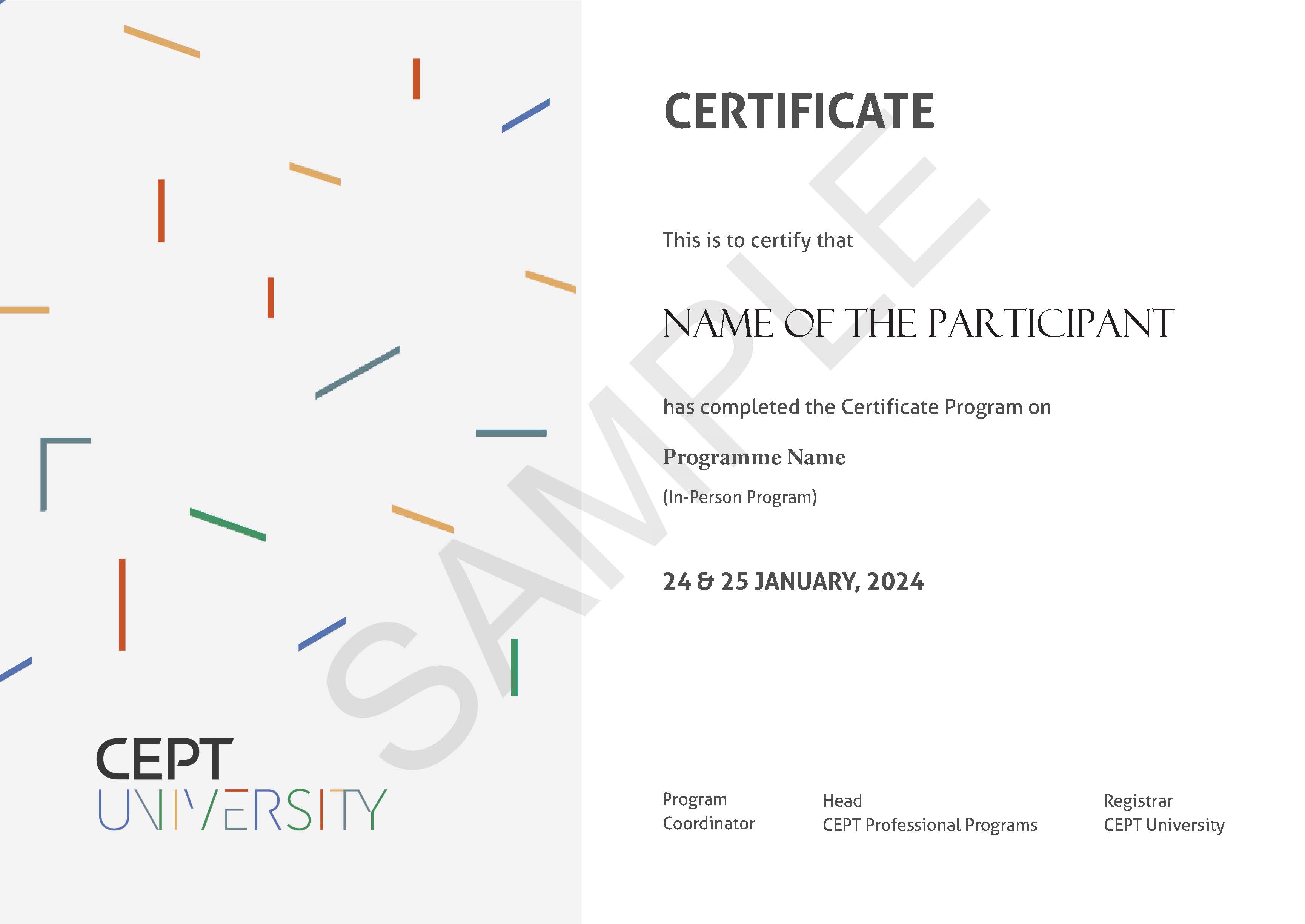
- Co-branded Certificate from CEPT University, The World Bank and New Development Bank
- INR 59000 + GST
The program fee includes a comprehensive package covering the welcome kit, study materials, and single-occupancy accommodation with meals for two nights during the on-campus module.
A discount of INR 9,000/- on the abovementioned fee is available for female applicants , CEPT Alumni and officials working on projects funded by the World Bank / New Development Bank. - The program is open to professionals across various fields, including practicing civil and construction engineers, structural engineers, architects, site engineers, project managers, Environmental Engineers and construction supervisors. It also welcomes participants from related sectors such as real estate and infrastructure development.
About
CEPT Professional Programs (CPP), CEPT University with technical support from the World Bank and the New Development Bank, presents blended co-branded Professional Certificate Program on Construction Project Management, comprising 18 days of online sessions and 2 days of on-campus sessions. This blended program is designed for professionals seeking to deepen their knowledge and enhance their skills in managing construction projects efficiently and effectively.
The course provides participants with a comprehensive understanding of key concepts, tools, and techniques in construction project management. Through a blend of theoretical insights, practical case studies, and applied learning, the program addresses crucial areas such as project planning, risk management & control, cost estimation, contract administration, procurement, project monitoring, Stakeholder analysis, Digital construction, project management software's, quality management, and construction project delivery.
Participants will benefit from interactions with expert faculty from CEPT University and industry leaders, as well as insights into global best practices supported by the extensive knowledge base of the World Bank and the New Development Bank. The program aims to equip professionals with the ability to manage construction projects from conception to completion, ensuring adherence to timelines, budgets, contracts, and quality standards.
By the end of this certification, participants will emerge with the confidence and competence to tackle complex challenges in construction management and contribute to the successful delivery of projects in today's dynamic infrastructure landscape.
Program Faculty
Ganesh Devkar
Lean Project Delivery, Public Private Partnerships, Megaprojects
Sr. Associate Professor, CEPT University
Jyoti Trivedi
Construction management, Contract management, IT in Construction (BIM)
Sr. Assistant Professor, CEPT University
Devanshu Pandit
Project management , Mass Housing , Waste Management, Water Supply & Sewerage
Adjunct Professor, CEPT University
Purvesh Raval
Construction management & Value Engineering
Assistant ProfessorGuest Speakers

Vandana Bhatt
Construction Law, Construction management
Adjunct Associate Professor, IIT Bombay
Anindo Chatterjee
Social Sustainability, Social Risk Management, Environment, Social & Governance (ESG)
Sr. Social Development Specialist, The World Bank
Sagar Deshmukh
Strategic Policies and Planning, Road Asset Management and Innovative Designs
Executive Director of LASA
Manish Trivedi
Structured finance, M&A, ESG, Due Diligence
Finance and Management Professional, Consultant P&L
Virat Kumar Dhebar
Quality Management, Operations Management
Founder & CEO at Knowledge KraftProgram Structure
-
Module 01
The program begins with an exploration of the conceptual stage of a construction project, emphasizing the analysis of Political, Economic, Social, Technological, Environmental, and Legal (PESTEL) factors. Participants will examine the problems that the project aims to address and engage in comparing various options to tackle the focal problem. The session will also cover project scoping, highlighting its importance in the overall conceptualization process. Subsequent sessions focus on critical aspects of stakeholder management and technological viability in construction projects. Participants will learn how to identify stakeholders and manage their engagement, using real-life construction project examples to create a stakeholder register. The day concludes with a discussion on assessing the technical feasibility of construction projects and the significance of selecting optimal project locations. This analysis is essential for ensuring project success and resilience in meeting user demand amid uncertainties.
-
Module 02
Participants delve into the crucial aspects of risk management and financial management throughout the project lifecycle. The first session emphasizes the importance of identifying diverse project risks, assessing their severity, and developing effective risk response and control strategies to mitigate potential impacts. Following his, the program shifts focus to financial considerations, highlighting the preparation of realistic cost estimates during the project appraisal stage. Participants will learn about the significance of block cost estimates and cost breakdown structures to understand various financial commitments. The final sessions of the day center on Financial Monitoring and Control, covering essential topics such as managing cash inflows and outflows, strategies for working capital management, and overseeing contractor invoices to ensure effective financial management throughout the project lifecycle.
-
Module 03
The third module program focuses on the critical phase of procurement strategy following the assessment of project viability concerning finance, risks, stakeholders, and technology. The first two sessions emphasize the onboarding of consultants and contractors, covering key topics such as determining procurement strategies, various types of contract agreements, designing bidding processes, and clarifying the roles and responsibilities of different consultants involved in the project. The program then delves into the Engineering, Procurement, and Construction (EPC) model, exploring its context, the drafting of EPC contract agreements, and the selection and monitoring of EPC contractors. The final session introduces the Public Private Partnership (PPP) model as an innovative procurement strategy widely used in infrastructure delivery. Participants will examine different types of PPP models, their characteristics, and review examples of PPP projects across various infrastructure sectors.
-
Module 04
Module 4 focuses on crucial dimensions of project execution, emphasizing quality, health and safety, environment, and social considerations, and contract management. The first two sessions focus on contract management, which is vital for effective project execution and meeting client expectations after work has been awarded to contractors. First session covers contract administration and claims handling, with a focus on managing scope changes, force majeure claims, and time extensions. Finally, session two discusses equitable dispute resolution, arbitration processes, and the critical aspects of contract closure and asset handover, ensuring a smooth transition post-project completion. Session three discusses socio-economic analysis, underscoring their significance in ensuring successful project outcomes. The latter part of the day shifts attention to planning and monitoring of health and safety management and quality assurance and control processes, highlighting the importance of integrating these dimensions during the design and procurement phases.
-
Module 05
Module 5 emphasizes the importance of developing a comprehensive project plan that includes detailed scheduling, monitoring, and control mechanisms. The first two sessions focus on various planning and scheduling tools, such as Critical Path Method (CPM) and Program Evaluation and Review Technique (PERT). Participants will gain hands-on experience with MS Project software to effectively plan and schedule projects. Additionally, the sessions will cover the establishment of baselines for tracking, monitoring, and controlling projects using Earned Value Management and performance indicators. The latter sessions address the challenges of conventional construction processes, which often result in fragmented teams and communication breakdowns that lead to delays and increased costs. Participants will explore the necessity of integrated and collaborative approaches in construction. The sessions will introduce technology enablers that enhance planning, coordination, and execution of projects, highlighting the use of Building Information Modeling (BIM) and Lean practices for real-time collaboration, clash detection, and overall improved project management efficiency.
-
Module 06
There will be an insightful site visit to a construction site, where participants will explore advanced construction techniques. Following this, a session, which delves into lean principles and various lean tools applicable to construction sites. This session will emphasize how these tools can enhance efficiency and reduce waste in construction processes. The session will also focus on adoption of lean tools in project delivery within the public sector, discussing strategies to optimize project outcomes through lean methodologies.
Applications and Admissions
The program is open to professionals across various fields, including practicing civil and construction engineers, structural engineers, architects, site engineers, project managers, Environmental Engineers and construction supervisors. It also welcomes participants from related sectors such as real estate and infrastructure development.
Applications are open. The program deadline is tentative, and applications will be reviewed on a rolling basis. Seats are allocated on a first-come, first-served basis, and admissions will close once all seats are filled.
Sample Certificate