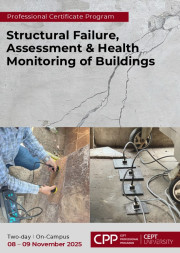
- 08 Nov 2025 to 09 Nov 2025
- 2 Days
- On-Campus
- Certificate from CEPT University
- INR 7500 + GST
(Discounts: For Early bird and other Discounts refer to the brochure) - Civil Engineers, Structural Engineers, Construction Engineers, Structural Lab technicians, Researchers and PhD Scholars in Structural Engineering.
About
Structural failures in buildings often arise from material degradation, design limitations, construction practices, or external influences. For the engineers, the ability to recognise early signs of distress and apply systematic assessment and monitoring methods is essential to ensure safety, serviceability, and long-term performance.
This program provides insights into the study of structural failures, assessment methodologies, and health monitoring techniques. It integrates theoretical knowledge with field-based learning, combining lectures on failure mechanisms and structural distress with practical exposure to non-destructive testing methods and monitoring tools. Discussion on case studies, guided site visits and on-site demonstrations reinforce classroom concepts, offering participants an applied understanding of diagnostic and evaluation practices.
The course is designed for structural engineers, civil engineering professionals, and researchers working in the areas of building assessment, retrofitting, and structural performance evaluation.
By the end of the program, participants will be able to classify failure modes, apply diagnostic and monitoring frameworks, and interpret assessment data to support informed decision-making. The course emphasizes both technical rigour and practical application, preparing participants to engage with the challenges of structural assessment in a professional context.
Program Faculty

Pratik Gajjar
PhD | Structural Engineer
Assistant Professor, CEPT UniversityProgram Structure
-
Understanding Structural Failures, Assessment, and Monitoring
The program will begin with an overview of the course and a discussion on why understanding structural failure is crucial for engineers. Participants will be introduced to material deterioration across reinforced concrete, steel, masonry, and timber, along with the key factors that lead to distress in buildings, such as design shortcomings, poor construction practices, and environmental exposure. The day will then move into preliminary structural assessment techniques, focusing on how to identify early warning signs and apply non-destructive testing methods such as infrared thermography, ground-penetrating radar, rebound hammer, and ultrasonic pulse velocity. Through guided discussions and case studies, participants will learn how to interpret data from these methods and apply it to real-world conditions. The day will conclude with an introduction to structural health monitoring, exploring how continuous or periodic measurement can be used to ensure building safety and long-term performance. Case studies will illustrate how monitoring systems have helped prevent failures and inform retrofitting decisions.
-
Applied Learning: Site Visits and Field Demonstrations
The second day will take participants into the field for immersive, hands-on learning. At selected building sites, they will examine structural systems and load transfer mechanisms while identifying failure patterns through guided exercises. Damage mapping and structural sketching activities will train participants to document observed defects systematically. This will be followed by on-site demonstrations of non-destructive testing tools, where participants will gain direct exposure to applying techniques introduced on Day 1. They will quantify damage, practice data collection, and prepare sample assessment reports under guidance. The program will conclude with demonstrations of advanced structural health monitoring systems, showing how real-time data can support informed decision-making. A closing discussion will allow participants to reflect on lessons learned, linking theoretical knowledge with professional application. By the end of the program, participants will have developed a clear framework for diagnosing, assessing, and monitoring structural failures.
Applications and Admissions
Civil Engineers, Structural Engineers, Construction Engineers, Structural Lab technicians, Researchers and PhD Scholars in Structural Engineering.
Sample Certificate