

- 13 Jun 2026 to 11 Jul 2026
- 20 hours of facetime over 4 weeks
- Blended (online + on-campus)
- Co-branded Certificate from CEPT University , The World Bank & The New Development Bank
- INR 54000 + GST
Discounts:
- Early bird discount: INR 14,000/- (till 15 May 2026)
- For Female Applicants and Officials working on World Bank/ New Development Bank funded projects: INR 10,000/- - City officials, Urban Planners, Infrastructure Planners, Urban practitioners and Consultants, Professionals from urban Infra Development fund, multilateral funding organizations, banks and financial intermediaries.
About
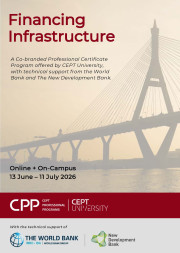
CEPT Professional Programs (CPP), CEPT University, with technical support from the World Bank and the New Development Bank, presents a four-week-long co-branded Professional Certificate Program on “Financing Infrastructure” for mid-career professionals from urban local bodies, financial institutions, multilateral agencies, and consulting firms. The program covers fundamentals and advanced concepts in project finance, regulatory frameworks, financial and economic analysis, Public-Private Partnerships (PPPs), and sector-specific case studies. It includes a site visit to a major infrastructure project and stakeholder interactions for practical insights. Designed as a blend of academic theory and real-world practice, the course helps participants identify bankable projects, navigate capital markets, and understand regulatory and fiscal challenges. Participants will benefit from interactions with expert faculty from CEPT University and industry leaders, as well as insights into global best practices supported by the extensive knowledge base of the World BankandtheNewDevelopment Bank. An excellent opportunity for professionals seeking to deepen their expertise in infrastructure finance and expand their impact.
Program Faculty
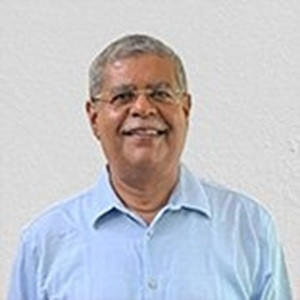
Pranavant
Dean - Faculty of Management

Astha Agarwalla
Assistant Professor
CEPT University
Ganesh Devkar
Lean Project Delivery, Public Private Partnerships, Megaprojects
Sr. Associate Professor, CEPT UniversityGuest Speakers

Poonam Ahluwalia
Senior Municipal Engineer, The World Bank Group

Tushar Arora
Senior Financial Sector Specialist, The World Bank

Riddhiman Saha
Urban Specialist, The World Bank
Program Structure
-
Module 1 - Overview of City Economic Development and role of Infrastructure
Cities are engines of economic growth, driving job creation through their local economic base, infrastructure, and agglomeration economies. Identifying bankable projects and integrating urban with economic planning are crucial. This module also explores financing options and stakeholder roles, with a case study on Surat or MMRDA. Key Questions: What drives economic growth and job creation in cities? How do agglomeration economies and infrastructure linkages affect development? What makes a project bankable and which investments qualify? How can urban and economic planning be effectively integrated? What financing sources can support these infrastructure projects?
-
Module 2 - Introduction to project Finance – Difference Between Funding and Financing
This module introduces project finance, distinguishing it from corporate finance, and highlights the importance of bankable projects and key market players. It covers various funding and financing sources, stakeholder roles, and decision-making in project structuring, including hybrid models. Real-world examples illustrate how to engage lenders and investors for urban infrastructure projects. Key Questions: What distinguishes project finance from corporate finance, and why does it matter? Who are the key stakeholders, and what roles do they play in project finance? What are the main sources of funding and financing for city infrastructure? How do you approach lenders and investors with bankable projects? When and how are hybrid financing models like blended finance or Viability Gap Funding used?
-
Module 3 - Economic Analysis of Projects
This module explores economic analysis of projects, distinguishing economic viability from financial feasibility. It covers methodologies like Cost-Benefit Analysis, Economic Rate of Return, and Social Return on Investment, while assessing impacts on growth, employment, and the environment. Understanding economic impact is crucial as it highlights the broader benefits of projects, including job creation and sustainable development. Key Questions: How do economic viability and financial feasibility differ? What methodologies assess a project’s economic impact?
-
Module 4(a) - Financial Analysis of Projects, Structures, and Instruments
This module covers project cash flows, including revenues, costs, and expenses, and key financial assessment methods like NPV, IRR, and DSCR. It explores differences between public and private sector finance, sources of project funding, and debt and equity structuring. Credit enhancement tools such as guarantees and insurance are also discussed. Key Questions: How are project cash flows structured and analyzed financially? What financial metrics are used to assess project viability?
-
Module 4(b)- Gender and Climate Toolkit
This module focuses on mainstreaming climate resilience and gender in project structuring. It equips participants with tools to identify and address climate and gender risks throughout the project cycle. It emphasizes inclusiveness, sustainability, and equitable outcomes in all project stages.
-
Module 5 - Financial Documentation and Regulatory Framework
This module covers key project finance documents such as loan agreements, term sheets, and financial covenants. It explains the roles of security packages, sponsor commitments, and key regulators like RBI and SEBI. It also addresses refinancing, debt restructuring, and relevant state-level borrowing rules. Key Questions: What are the critical documents and terms in project finance? How do regulatory frameworks and institutions impact project financing? What mechanisms exist for refinancing and debt restructuring?
-
Module 6 - Sector-Specific Applications of Project Finance
This module examines financing strategies for urban infrastructure, real estate, technology, and innovation sectors. It highlights how public and private sectors approach funding urban development projects differently. The focus is on customized financing solutions that address the unique challenges of growing cities and urban economies.
-
Module 7 - Advanced Topics in Project Finance
This module covers green finance, ESG principles, and the role of AI in risk assessment for sustainable urban development. It explores impact investing and climate budgeting as tools for climate action planning. Participants will learn about climate finance sources, current gaps, and strategies to access funding, supported by real-world case studies.
-
Module 8 - Risk Identification, Allocation, and Mitigation
This module covers key project risks—including construction, operational, market, political, and environmental—and explores strategies for risk allocation through contracts, insurance, and guarantees. It examines both qualitative and quantitative risk assessment methods, credit rating roles, and dispute resolution mechanisms. Public and private sector perspectives are compared, supported by case studies of risk management successes and failures. Key Questions: What are the major risks in infrastructure projects and how are they assessed? How are risks allocated between stakeholders in contracts and insurance? What lessons do case studies offer on effective risk management?
-
Module 9 - Public-Private Partnerships (PPPs) & Alternative Modalitie
This module introduces Public-Private Partnerships (PPPs), covering their key characteristics and common models like BOT, BOO, and DBFO. It reviews legal frameworks, risk-sharing mechanisms, and assessment tools such as Value for Money and Public Sector Comparator. Comparative case studies illustrate practical applications and outcomes. Key Questions: What are the main PPP models and their features? How are risks shared and assessed in PPP structures? How do assessment methodologies ensure value for money in PPPs?
-
Module 10 - Capstone Project & Assessment
The Capstone Project involves team-based structuring of a project finance deal, including developing a financing plan, conducting risk analysis, and building a financial model. Participants will present their proposals to a mock investment committee. The module concludes with a course wrap-up and reflections.
Applications and Admissions
This Program is open to City officials, Urban Planners, Infrastructure Planners, Urban practitioners and Consultants, Professionals from urban Infra Development fund, multilateral funding organizations, banks and financial intermediaries.
The program deadline is tentative, and applications will be reviewed on a rolling basis. Seats are allocated on a firstcome, first-served basis, and admissions will close once all seats are filled.
Participants will receive a co-branded certificate from CEPT University, The World Bank and The New Development Bank on successful completion of the program with a minimum of 80 per cent attendance.
Sample Certificate
